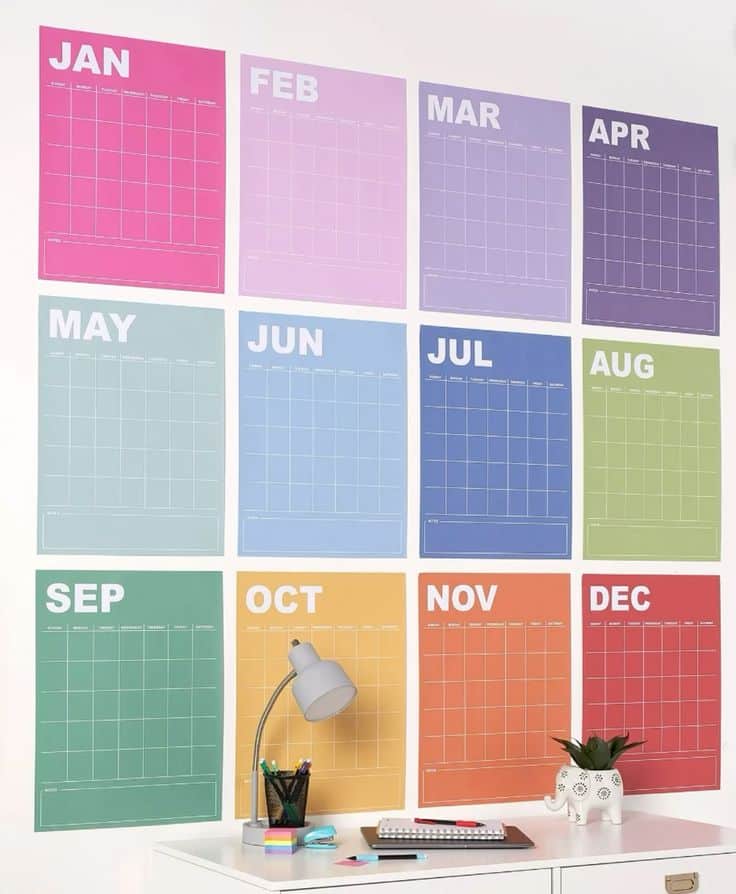
Social media editorial calendar: the method to get organized and keep up the pace
TL;DR
Publishing on a whim leads to inconsistency and burnout. An editorial calendar transforms your social media presence into a managed strategy: regularity, a clear direction, and time saved. This guide explains what a good calendar should contain, how to build it, and how to find the right rhythm.
Most brands aren't short on ideas—they lack organization. They publish when they think of it, freeze up on Monday, post three times on Thursday, then nothing for ten days. The result: an erratic presence that both the algorithm and the audience penalize. An editorial calendar is the simplest tool to break this cycle. Here's how to set one up.
Why an editorial calendar changes everything
An editorial calendar is the advance planning of your publications: what, when, on which platform, and for what purpose. Its benefits extend far beyond mere organization. It guarantees consistency—the factor that algorithms value most. It forces you to think ahead about the coherence of your editorial line rather than reacting in a rush. It distributes formats and themes to avoid monotony. And it saves considerable time by combining planning and production. In short: it transforms a daily chore into a controlled process.
What a good editorial calendar should contain
- The date and time of publication : to visualize the pace and avoid gaps like traffic jams.
- The platform : each network has its own codes; the same message adapts, it cannot be copied and pasted.
- The format : Reel, carousel, story, post… to guarantee variety.
- The theme or content pillar : to balance the topics and stay true to your line.
- The objective : awareness, engagement, traffic, conversion — every post must serve a purpose.
- Status : to produce, in progress, ready, published — to track progress.
How to build your editorial calendar
- Start with your objectives and your audience : you can't plan in a vacuum. Knowing who you're talking to guides everything — hence the usefulness of creating personas beforehand.
- Define your content pillars : 3 to 5 major recurring themes that structure your speech and avoid writer's block.
- Choose a sustainable pace : a little and regular is better than a lot and then nothing.
- Plan in blocks : prepare one to several weeks in advance, grouping production (batching) to gain efficiency.
- Keep it flexible : reserve slots for news and spontaneous opportunities — a calendar guides, it does not imprison.
The calendar is not an end in itself: it's the operational arm of your social media strategy. Without a strategy behind it, it's just an empty schedule.
Finding the right publishing rhythm
The question "how often should I publish?" doesn't have a universal answer. The right pace is the one you can maintain over time without sacrificing quality. A brand that publishes twice a week, regularly, with carefully crafted content, performs better than a brand that posts every day for a month before running out of steam. Consistency trumps frequency, and quality trumps quantity. Adapt your posting schedule to your actual resources, not to an unattainable ideal.
Tools for managing your calendar
No need for a major investment to get started: a simple spreadsheet is enough to structure your initial calendar. To go further, scheduling tools (Metricool, Later, Buffer, Hootsuite, and similar services) allow you to schedule posts and centralize tracking. The tool doesn't create the strategy; it executes a pre-defined schedule. And regardless of the tool, monitor the results to make adjustments—see our guide on KPIs to track.
Frequently asked questions about the editorial calendar
What is an editorial calendar for social media?
It's about planning your publications in advance: what to publish, when, on which platform, in what format, and for what purpose. It guarantees regularity, ensures consistency in your editorial line, and saves time by combining planning and production.
How often should you post on social media?
There's no universal ideal posting frequency. The right pace is the one you can maintain consistently without sacrificing quality. Regularity matters more than frequency: two well-crafted, consistent posts per week are better than a daily peak followed by silence. Adapt your posting schedule to your actual resources.
What tools are available to create an editorial calendar?
A simple spreadsheet is all you need to get started. To schedule posts and centralize tracking, tools like Metricool, Later, Buffer, or Hootsuite are useful. But the tool doesn't create the strategy: it executes a pre-designed calendar based on your objectives and audience.
Structure your social media with So Bang
So Bang, a social media agency in Paris, builds and manages brands' social media presence—strategy, editorial line, calendar, production, and results measurement—for all sectors. Say goodbye to spontaneous posting: it's an organized, results-oriented approach. Contact So Bang to structure your social media presence.